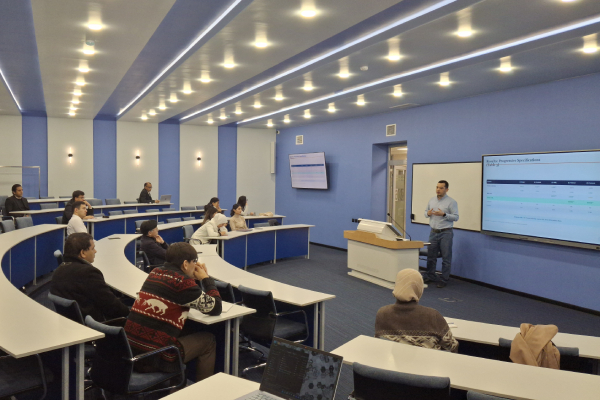
On December 10, 2025, PhD candidate in Management Abbos Azizov presented his research, "Female Leadership and Innovation in Emerging Market SMEs: Causal Evidence from Lower-Middle Income Countries."
Using data from 44,193 SMEs across 43 countries, the study provides causal evidence that female leadership increases the likelihood of SME innovation by 5.97 percentage points. A key finding is that this positive effect only emerges in environments with stronger legal gender equality, highlighting the critical role of institutional support. The research offers important insights for policies aimed at fostering innovation through female entrepreneurship in developing economies.
Abstract:
Purpose: This study examines how female leadership drives innovation in small and medium enterprises (SMEs) across emerging markets, addressing a critical gap in understanding causal relationships between entrepreneurial leadership and innovation outcomes in developing economies.
Design/methodology/approach: We employ instrumental variables methodology using owner gender to establish causal relationships between female leadership and SME innovation. Our analysis encompasses 44,193 SMEs across 43 lower-middle income countries from the World Bank Enterprise Survey (2007-2022). The identification strategy exploits variation in female leadership selection determined by ownership characteristics rather than innovation potential, enabling causal inference across diverse institutional environments.
Findings: Female leadership causally increases SME innovation likelihood by 5.97 percentage points, representing a 24.6% improvement over baseline rates. This relationship exhibits critical institutional contingency: positive effects emerge only when the Women, Business and the Law Index exceeds 40, with effects strengthening as legal gender equality improves. Results remain consistent across firm sizes. The strengthening of coefficients when addressing endogeneity reveals that selection bias works against female leaders in emerging market SMEs.
Research limitations/implications: The cross-sectional design prevents examining dynamic leadership transitions over time. Future research should employ longitudinal designs and richer innovation measures capturing quality and economic impact.
Practical implications: SME development programs should prioritize female leadership as a concrete innovation strategy. However, effectiveness requires supportive institutional frameworks—policymakers should integrate gender equality reforms with SME development strategies while promoting female participation in entrepreneurial leadership.
Originality/value: This study provides the first causal evidence on female leadership-innovation relationships in emerging market SMEs. The institutional threshold discovery (WBL > 40) represents a novel contribution linking legal frameworks to entrepreneurial leadership effectiveness, offering evidence-based foundations for small business development policy.
Keywords: Female leadership, SME innovation, Small business development, Entrepreneurship, Emerging markets, Institutional support, Instrumental variables, Lower-middle income countries.