
Graduate Café Hosts Special Session on Doctoral Education Reform in Uzbekistan
On June 29, 2026, the Graduate Café convened a special online session featuring Dr. Kobil Ruziev, Associate Professor and expert on political economy, institutions, and higher education reform in Central Asia. Dr. Ruziev presented on "Reforming Doctoral Education in Uzbekistan: Models, Rules and Norms of Behaviour," offering a comprehensive analysis of the ongoing transformation of doctoral programs in the country.
Drawing on his extensive research and participation in international capacity-building projects, Dr. Ruziev examined the evolving regulatory frameworks, institutional governance structures, and shifting norms that shape the doctoral journey in Uzbekistan. He highlighted both the challenges—such as building sustainable research capacity and strengthening quality assurance—and the opportunities presented by recent reforms aimed at aligning doctoral education with international standards.
The session sparked a lively discussion among participants, including graduate students, early-career researchers, and academic staff, who engaged with questions on institutional change, supervision models, and the future of research culture in Central Asia.
We extend our sincere thanks to Dr. Ruziev for his insightful presentation and to all attendees for their thoughtful contributions.
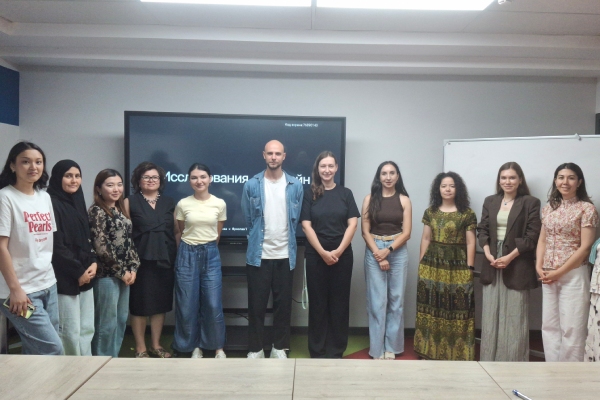
On June 24, 2026, the Graduate School (Research) hosted an engaging session of the Graduate Café featuring Yulia Kozhukhova and Yaroslav Tugulovskiy, who presented a practical case study titled, "Research and Design: A Practical Case Study of Uzum" ("Исследования и дизайн: практический пример Uzum").
The session offered an in-depth look at how research and design principles are applied in the development of digital products and services, using the Uzum ecosystem as a real-world case study. Presenters shared valuable insights into the intersection of user research, design thinking, and product development within Uzbekistan's growing tech landscape. The session successfully bridged academic research with industry practice, sparking an engaging discussion among participants.
The Graduate Café once again served as a platform for exploring practical applications of research in Uzbekistan's rapidly evolving digital economy.
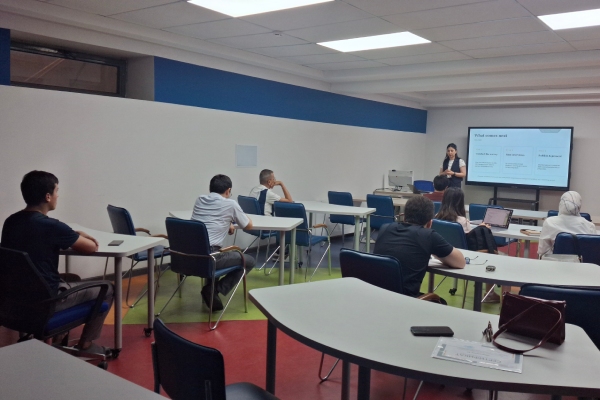
On May 20, 2026, the Graduate School (Research) hosted a session of the Graduate Café featuring Mokhirakhon Abdullaeva, PhD candidate in Management. She presented her introductory research titled, "Management of Fintech Integration in Digital Organizations in Uzbekistan: An Introduction."
During the session, Mokhirakhon shared the initial stages of her dissertation, including a comprehensive literature review on fintech integration and the preliminary methods she plans to employ in her study. She discussed key theoretical frameworks, identified research gaps in the Uzbek context, and outlined her proposed methodological approach for investigating how digital organizations in Uzbekistan are navigating fintech adoption.
Following the presentation, Mokhirakhon received constructive recommendations from academic staff members to further refine her literature review and strengthen her research methodology.
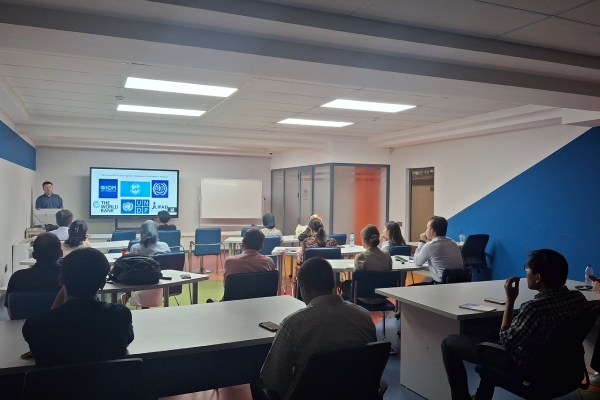
On May 6, 2026, the Graduate School (Research) hosted a special session of the Graduate Café featuring Matthew Heneghan, PhD candidate at the University of Glasgow. He presented his research titled, "Financializing Remittances in Central Asia: With and Without Markets."
The session examined the complex dynamics of remittance financialization across Central Asian economies. Matthew explored how remittance flows—vital to the region's households and national economies—are increasingly being integrated into formal financial systems through both market-based and non-market mechanisms. Drawing on empirical research from across the region, the presentation analyzed the implications of this trend for migrant workers, recipient families, financial institutions, and policymakers.
Attendees gained insights into the opportunities, challenges, and unintended consequences of financializing remittance flows in diverse institutional contexts. The discussion highlighted the unique characteristics of Central Asian remittance corridors and their implications for development policy.
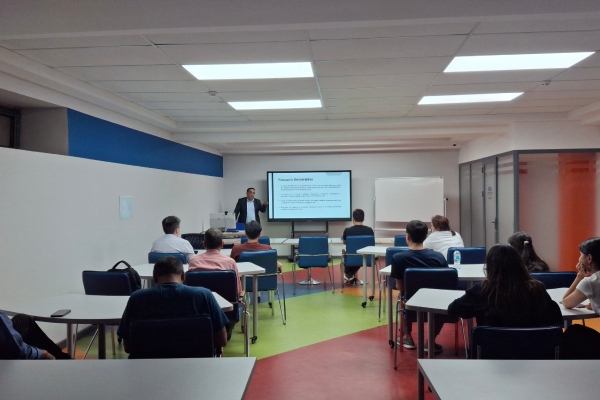
On April 29, 2025, the Graduate School hosted an engaging session of the Graduate Café featuring Azizjon Khatamov, PhD candidate in Management. He presented his ongoing research titled, "Prospects of Implementing Artificial Intelligence in Compliance Management within Commercial Banks."
The session examined the transformative potential of artificial intelligence in revolutionizing compliance management practices within commercial banks. Azizjon discussed his research in progress, noting that he is currently collaborating with a bank's team to analyze AI applications in real-world compliance settings.
Attendees gained valuable perspectives on key AI applications in compliance, including automated transaction monitoring, real-time risk assessment, regulatory reporting, and fraud detection. The presentation also addressed challenges such as data privacy concerns, integration with legacy systems, and regulatory acceptance.
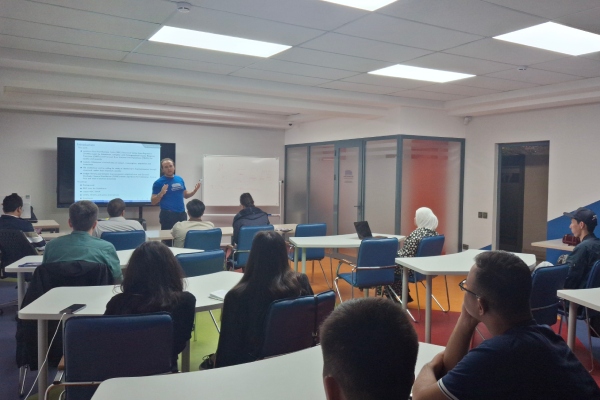
On April 22, 2026, the Graduate School (Research) hosted an engaging session of the Graduate Café featuring Alessandro Saccal, Senior Lecturer and DSc candidate in Econometrics and Statistics. He presented his study titled, "A Structural Vector Auto-Regression for Uzbekistan's Real Business Cycle Model."
The session delved into the application of Structural Vector Auto-Regression (SVAR) techniques to model Uzbekistan's real business cycle dynamics. Alessandro explored how macroeconomic shocks—such as changes in productivity, policy, or external demand—propagate through the Uzbek economy and influence key variables including output, consumption, investment, and employment.
Attendees gained valuable insights into the methodological foundations of SVAR models, their advantages for analyzing emerging economies, and their practical application for understanding business cycle fluctuations in Uzbekistan's unique economic context. The presentation successfully bridged econometric theory with real-world policy analysis, sparking a thoughtful discussion among participants.
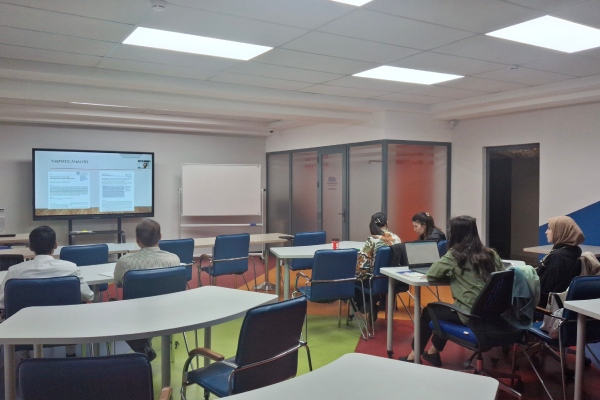
On April 15, 2025, the Graduate School (Research) hosted an engaging session of the Graduate Café featuring Bakhytzhan Kurmanov, Senior Research Fellow at IPPA. He presented a practical seminar titled, "Thematic Analysis and Qualitative Methods".
The session provided a comprehensive introduction to thematic analysis as a widely used tool for processing and interpreting qualitative data. Bakhytzhan guided participants through the main stages of thematic analysis—from initial data coding to the development and interpretation of themes—while exploring both inductive and deductive coding approaches.
Attendees gained insights into how researchers can identify key meanings and recurring patterns in interviews, texts, and other materials, systematize findings, and connect them to broader research frameworks. The seminar also introduced supporting tools, including manual coding techniques and specialized qualitative data analysis software, illustrated with real-world project examples.
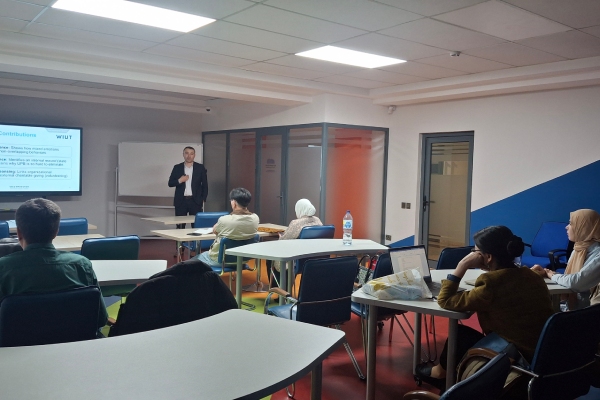
On April 8, 2026, the Graduate School (Research) hosted an engaging session of the Graduate Café featuring Sherzodbek Dadaboev, DSc candidate in Management at Westminster International university in Tashkent. He presented his research titled, "Paradoxical Consequences of Unethical Pro-Organizational Behavior: A Dual-Path Model."
The presentation explored a fascinating question: why do good employees sometimes do bad things for their company, and what happens to them afterward? Sherzodbek delved into the psychological aftermath of Unethical Pro-Organizational Behavior (UPB), introducing a novel dual-path model that explains the deep psychological paradox experienced by those who commit misconduct with the intention of helping their organization.
He presented findings from two complementary studies: a scenario-based experiment where participants imagined committing a UPB, and a time-lagged field survey conducted over ten weeks that measured actual past UPB, psychological states, and real volunteering behaviors using Structural Equation Modeling.
The session sparked a lively discussion among attendees on ethics, workplace psychology, and the unintended consequences of well-intentioned misconduct.
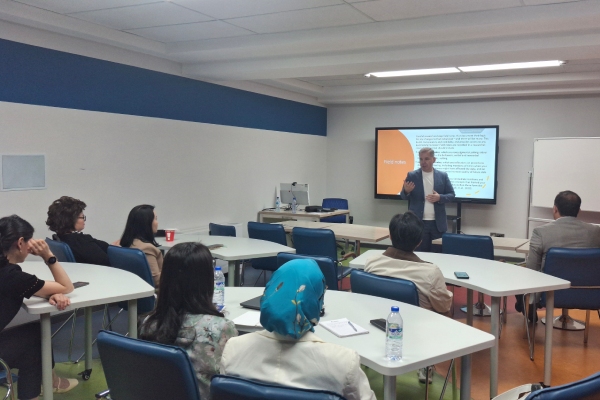
On March 25, 2026, the Graduate School (Research) hosted a thought-provoking session of the Graduate Café featuring Erkin Mukhammedov, PhD Candidate in Applied Linguistics at the University of Warwick. He presented his talk titled, "Beyond the Surface: Can Classroom Observations Ever Be Truly Objective?"
Drawing on insights from applied linguistics and educational research, He critically examined the complex nature of classroom observations as a tool for evaluation and professional development. He challenged assumptions about objectivity in observation practices, exploring how observer bias, contextual factors, and the inherent subjectivity of interpretation shape outcomes. The discussion delved into the broader implications for teacher evaluation, instructional improvement, and the pursuit of meaningful feedback in educational settings.
Participants engaged in a lively and reflective discussion, sharing perspectives on the challenges and possibilities of making observation practices more equitable and effective.
Contact us
Tashkent, Istiqbol st., 12
-
Extentions: ext 566
-
Enquiry office: (+998 71) 238 74 00
-
Enquiry office: research@wiut.uz
Follow Us